An original method to calibrate CONCERTO data
A forward model simulates spectral response and interferograms for each COSMOS scan, enabling precise calibration: ZPD variation with elevation measured per KID, stable flatfields, and a novel atmospheric-signal-based absolute brightness calibration for extended emission.
To ensure accurate calibration of the CONCERTO data, we developed a forward model capable of simulating the spectral response and the corresponding interferograms for each scan of observation in the COSMOS field. We present the modelling approach that enabled us to reproduce the expected instrument outputs under controlled input conditions and that provided a framework for the different calibration steps, including the absolute brightness calibration of the spectra.
We constructed a dedicated analysis pipeline to characterise the raw interferometric data (interferograms) obtained under a broad range of atmospheric conditions at APEX. Using the forward model, we measured the interferogram alignment with the optical path difference (zero path difference) and the relative response of each KID (flatfield). Together, these elements enabled us to characterise the instrument's spectral brightness calibration reliably.
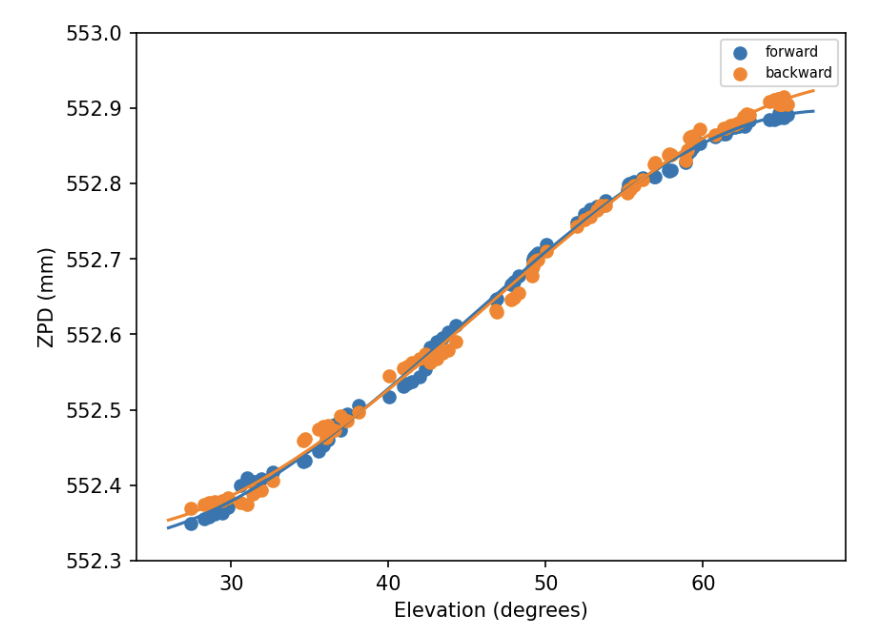
We demonstrated that the zero path difference systematically varies with elevation (Figure 1 below) and across detectors, with variations that are consistent with small optical misalignments and elevation-dependent mechanical effects in the optical structure. The full measurement of these variations allowed us to construct a data base that is used to determine the zero path difference for each measured individual interferogram accurately. The flatfield shows systematic variations with detector position, but is extremely stable with time and atmospheric contribution. The accurate determination of the zero path differences and flatfields allowed us to construct spectral cubes that combine all detectors and all blocks of data.
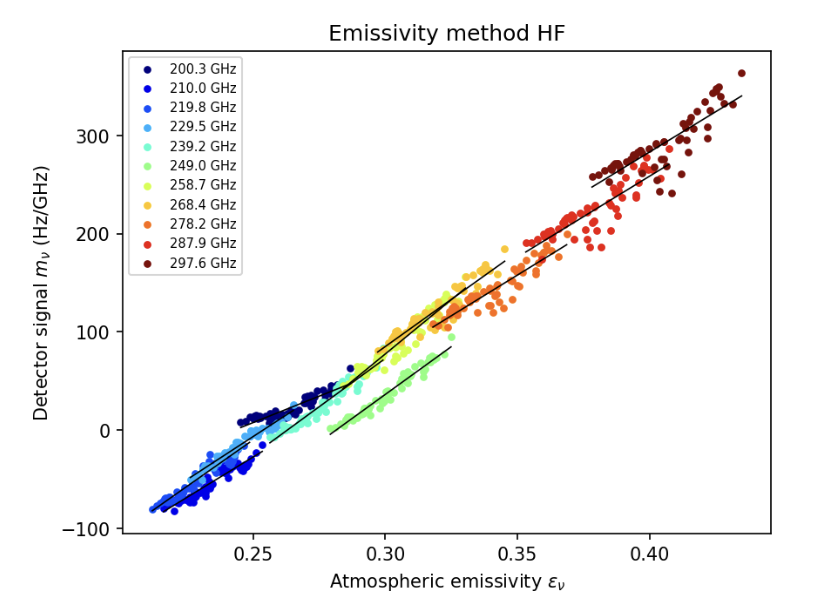
Finally, we present a novel method for calibrating the absolute brightness of these spectral cubes, which is agnostic to the exact knowledge of the bandpasses and directly applicable to extended emission. This method uses the atmospheric signal as a primary calibrator (see Figure 2 below)
Our analysis establishes a framework for precise calibration directly from on-sky data. This approach ensures a reliable performance for cosmological and astrophysical applications and can readily be adapted to future Martin-Puplett interferometer-based Fourier-transform spectrometers.